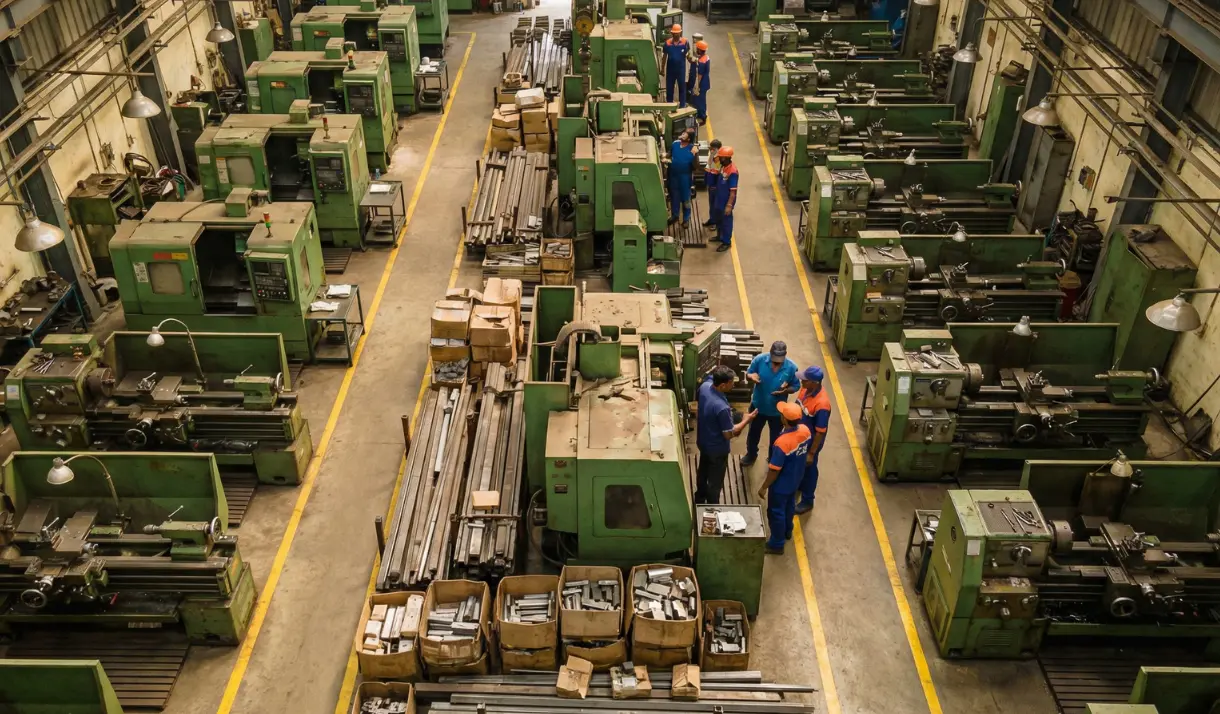

If German manufacturing is often celebrated for its precision, and Japanese manufacturing for its discipline, Indian manufacturing carries a distinct identity of its own – a remarkable capacity for Jugaad.
Jugaad (often misunderstood as just a workaround) is not the oversimplified version people sometimes joke about, but a deeper cultural instinct: the ability to stay resourceful under pressure, adapt quickly, and find solutions even when the odds, tools, or timelines are stacked against you.
But there is an important distinction that often gets blurred: Jugaad is a strength, not a system.
It excels at solving immediate problems but it was never designed to replace structured processes, long-term planning, or cross-team coordination. Depending on it every time is where many growing manufacturers begin to feel strain.
Where Jugaad Truly Works in Indian Manufacturing
Jugaad adds tremendous value in situations where agility and improvisation matter:
✓ Handling unexpected disruptions
Supplier delays, power fluctuations, or sudden machine behaviour – Jugaad keeps work moving.
✓ Finding temporary workarounds under pressure
When deadlines can’t shift and customers expect miracles, Jugaad steps in.
✓ Innovating with limited resources
From creating small fixtures to adjusting processes on the fly, teams use Jugaad to stay productive.
✓ Saving the day during true emergencies
When there is no time to wait for formal approvals, Jugaad becomes the difference between a missed shipment and a saved order.
In these cases, Jugaad is not only helpful it’s heroic.
Why factories should not rely solely on Jugaad
As factories scale, complexity increases quietly. More machines, more people, more vendors, more customers and far more decisions being made every day.
At this stage, Jugaad often shifts roles without anyone noticing.
What was once an occasional workaround starts filling gaps everywhere:
- Production schedules are adjusted verbally
- Inventory levels live in someone’s memory
- Approvals happen over calls or messages
- Critical processes depend on specific individuals
Nothing appears broken on the surface. Orders go out. Problems get “managed.” But the business begins relying heavily on people holding everything together through constant improvisation.
This is where the cost shows up, not always in financial statements, but in:
- Inconsistent outcomes
- Rising stress levels
- Repeated firefighting
- Limited visibility for owners and managers
Growth slows not because teams lack effort or intelligence, but because creativity is being used to compensate for the absence of consistency.
At this point, Jugaad is no longer just solving problems. It is quietly preventing the business from moving beyond them.
The Problem Isn’t Jugaad, It’s the Lack of System
Jugaad thrives when it has support. It struggles only when systems don’t exist to absorb complexity.
A modern manufacturing operation needs:
- Data visibility
- Standard workflows
- Traceability
- Quality consistency
- Cross‑team coordination
When such system is missing, Jugaad ends up doing too much of the heavy lifting. That is not a failure of ingenuity. It is a signal that the business has outgrown informal ways of working.
But with the right systems, Jugaad becomes elevated, not restricted.
How a Manufacturing ERP Converts Jugaad Into a Strength
As manufacturing operations grow, the challenge is no longer about solving problems quickly, it is about ensuring the same problems don’t need to be solved repeatedly.
This is where a manufacturing ERP helps.
By bringing production, inventory, and planning onto a single system, ERP creates shared visibility across teams. Decisions that once depended on memory, calls, or individual intervention begin to rely on real-time data and defined workflows.
Jugaad doesn’t disappear in this environment. It becomes more deliberate.
Applied where flexibility is required, not where structure is missing.
In this way, a manufacturing ERP transforms Jugaad from a survival instinct into a scalable strength.
The ERP Designed for the Jugaad Culture
Most ERP systems are built on an assumption that factories operate in predictable, standardised ways. Indian manufacturing rarely does.
For a manufacturing ERP to work here, it cannot fight the culture of Jugaad. It has to work with it, providing structure without removing flexibility, and discipline without disconnecting teams from the shop floor.
Instead of depending on memory, follow-ups, or informal coordination, it creates a shared operational backbone:
- Clear visibility without constant supervision
Decision-makers can see what’s happening across departments without slowing teams down or adding layers of reporting. - Coordination that doesn’t rely on people holding things together
Routine communication, approvals, and updates move through the system – reducing dependency on verbal handovers and individual intervention. - Processes that reflect real manufacturing behaviour
Changes in BOMs, order-specific requirements, subcontracting flows, and production routing are captured without forcing a one-size-fits-all path. - Planning that anticipates, not reacts
Material, production, and dispatch planning stay connected, so shortages and priorities are visible early before they become emergencies.
When ERP works this way, decision-making doesn’t slow down.
It becomes more confident, because information is available when it’s needed, not reconstructed later.
This is also the design philosophy behind SourcePro Manufacturing ERP. Rather than imposing rigid global templates, it focuses on structured flexibility, allowing factories to retain their agility while gaining consistency and control.
Conclusion: ‘Jugaad with Systems’ is the Way Forward
Jugaad has always been a defining strength of Indian manufacturing. It reflects resilience, adaptability, and the ability to solve problems under pressure. But as businesses grow, ingenuity alone can no longer carry the weight of increasing complexity.
The next phase is not about choosing between flexibility and structure, but about combining them. Jugaad with systems allows creativity to thrive within a framework that brings consistency, visibility, and scale.
Jugaad is the spark.
Systems are the engine.
Together, they build the future of Indian manufacturing.