
Capacity is one of the most referenced figures in manufacturing. It appears in sales commitments, production plans, and expansion decisions. But what it usually represents is potential, not performance.
The math is straightforward: installed machines, rated output, available hours. Logically consistent in theory, but rarely sustainable under real operating conditions.
Variability, shared constraints, rework, QC holds, and material gaps steadily reduce what is actually achievable. Declared capacity drifts away from usable capacity, yet the same number continues to guide promises.
That gap is the capacity illusion. And it quietly fuels rescheduling, overcommitment, margin erosion, and premature expansion.
How the Capacity Illusion Changes by Industry
The capacity illusion manifests differently in job shops and in process manufacturing, even though the underlying planning error is the same.
In job shops, the illusion hides behind shared bottlenecks and variable routing.
In process plants, it hides inside flow losses and waiting time between stages.
The symptoms look different.
The root mistake does not.
Capacity Illusion in Job Shops vs Process Manufacturing
| Aspect | Job Shop | Process Manufacturing |
| Main illusion | All machines are equally available | Line speed equals output |
| Real constraint | Bottleneck machine or skill | Flow interruptions and waiting |
| Capacity killer | Variability and shared resources | WIP, QC holds, changeovers |
| Planning mistake | Infinite loading | Ignoring non‑run time |
| Typical symptom | Constant rescheduling | “Running busy but shipping late” |
Job Shops: Where One Machine Decides Everything
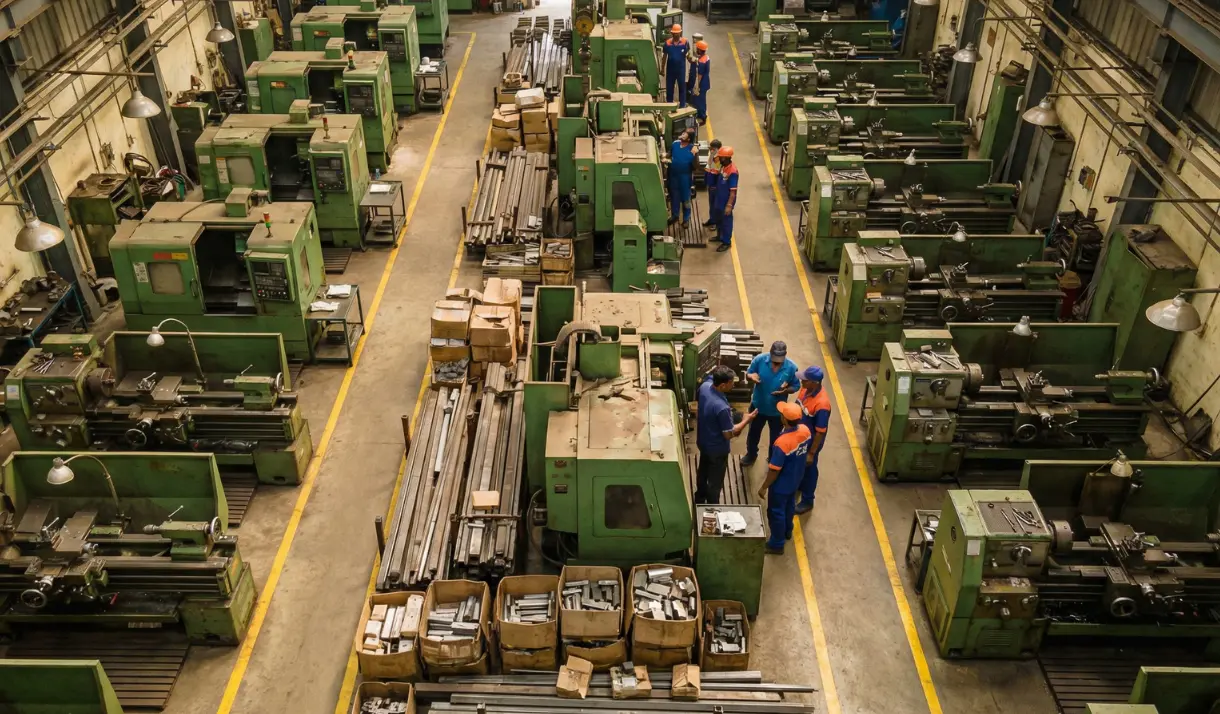
In machining, fabrication, or custom engineering environments, routing varies from job to job. Parts flow through different sequences, and at first glance, capacity appears distributed across multiple machines.
In practice, most jobs converge on the same critical resource, whether it is one CNC, one specialised operation, or one highly skilled operator. On paper, three similar machines may appear to offer balanced capacity. On the shop floor, one of them inevitably becomes the constraint.
When that bottleneck is overloaded, everything else waits, even if other machines stand idle.
What is usually underestimated are the factors that consume usable hours at the constraint: setup time, tooling changes, rework, urgent insertions, and operator dependency. The total available hours may look sufficient, but the usable hours at the bottleneck are already committed.
In a job shop, the most important capacity question is not how many machine hours exist in total, but how many usable hours remain at the bottleneck in the current planning window.
That number, not the installed total, is the factory’s real capacity.
Process Manufacturing: Where Capacity Leaks Through the Flow
In process manufacturing, such as chemicals, plastics, food, or pharmaceuticals, capacity appears more stable. Lines run continuously, and output is often expressed in tons per day or batches per shift.
Here, capacity is rarely constrained by variety. Instead, it is reduced by flow losses between stages.
Quality holds delay release. Cleaning and changeover cycles consume productive time. Tanks, buffers, or downstream availability limit movement. Material staging issues create waiting even when machines are technically running.
The line may operate all day, yet shipments still lag behind plan, because installed line speed is mistaken for effective output.
In process plants, capacity is not destroyed at the machine.
It is lost in waiting.
Why One Declared Number Fails Both
Most factories rely on a single statement:
“We can produce X per day.”
That number overstates capacity in job shops and oversimplifies it in process manufacturing. In both environments, it leads to overcommitment, missed dispatches, margin distortion, and chronic firefighting.
The issue is rarely a lack of equipment.
It is a lack of visibility into constraints.
Making Capacity Measurable
Capacity becomes predictable only when it is measured against real constraints, not theoretical hours. This is where a Manufacturing ERP changes the equation.
It does not increase machine speed or eliminate variability.
It makes constraints visible.
In practical terms, visible capacity requires four things:
Bottleneck Discipline (Job Shops)
Finite resource booking prevents double-loading of critical machines. If the constraint is full, the system forces dates to move, instead of quietly stacking work.
Flow Visibility (Process Plants)
Stage-wise WIP and QC tracking expose waiting time between operations. Installed line speed is separated from effective output.
Material-Linked Planning
Planning engines that check stock, purchase pipelines, and minimum levels before confirming schedules ensure capacity is not promised on unavailable materials.
Real-Time Production Booking
Routing-based job tracking replaces assumed progress with actual progress, making usable hours measurable rather than estimated.
ERP does not create capacity. It removes the illusion around capacity.
And once illusion disappears, planning becomes disciplined instead of reactive.
Conclusion: The Real Definition of Capacity
Capacity is not what machines can achieve under ideal conditions.
Capacity is what the system can reliably finish under real ones.
Until planning reflects actual bottlenecks, real flow losses, and live WIP, the number on the dashboard remains a declaration, not a capability. Decisions made on that illusion are expensive.
The factories that scale with confidence are not the ones with the most machines. They are the ones that know, at any moment, where their true constraint lies- and plan accordingly.