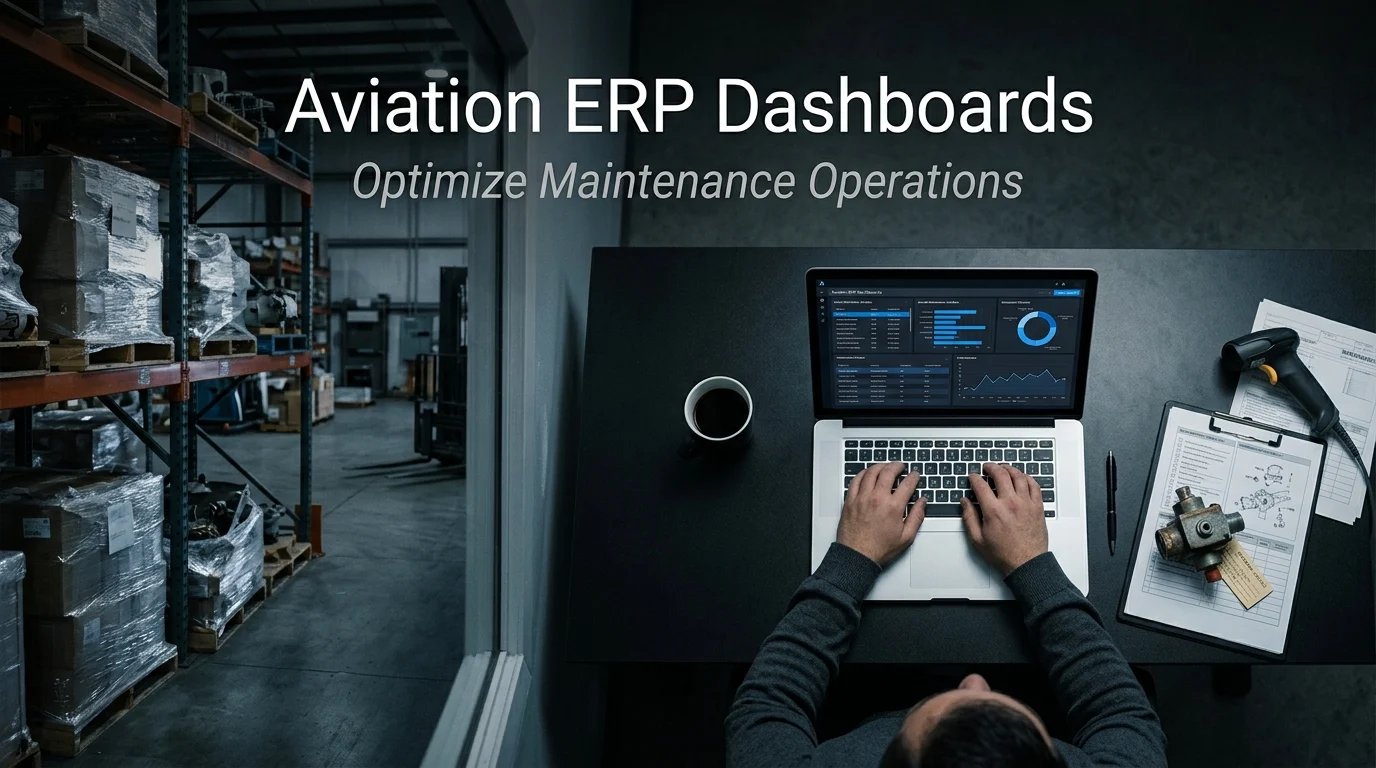

Aviation ERP is enterprise software that ties finance, procurement, inventory and maintenance to the regulated records an operator or MRO must keep. Judge any system on serial-level traceability, certification fit and audit evidence before you compare prices. This article gives an independent, procurement-focused view, with market figures, EASA Part-IS obligations and a selection checklist.
What is aviation ERP and how does it differ from standard ERP?
Aviation ERP is enterprise resource planning built around aircraft parts, maintenance records, airworthiness documents and regulated stock. It runs the same back-office functions as any ERP, but every transaction is anchored to an aircraft, a component or a maintenance task.
Standard ERP treats an item as a SKU with a quantity and a cost. That works for fasteners in a warehouse, but it breaks down when you must prove which serial-numbered unit sat in which position on which tail number, under which release certificate. Standard systems lack traceability to serial numbers, certificates and maintenance tasks, so teams fill the gap with spreadsheets and paper. That is where audit findings come from.
An aviation system adds time since new, cycles, shelf life, life limits, certificate attachments and status flags such as serviceable, unserviceable and quarantined. If the terms are new to your finance or IT colleagues, start with the core ERP modules. In aviation, the ones that carry the most weight are:
- Inventory and warehouse management
- Purchasing and supplier control
- Maintenance planning and work orders
- Quality and compliance records
- Finance and costing
How does aviation ERP help maintenance teams and MRO operations?
Aviation ERP helps maintenance teams plan work orders, track component life limits and close records faster. The gain comes from having one record that planning, stores, certifying staff and finance all work from.
In a typical MRO workflow, the system generates task cards from the maintenance programme, reserves the parts each card needs, and flags shortages before the aircraft is on the hangar floor. Component shop visits are tracked as their own jobs, with turnaround time measured from induction to release. Planners see which items are waiting on parts, on inspection or on paperwork, which is usually where turnaround is lost.
A worked example shows how the records fit together. Take a life-limited component removed and reinstalled during a check:
- A work order is raised from a task card that calls for removal.
- On removal, the system records the date, aircraft, position, and the hours and cycles accumulated. The component’s installed status ends.
- The unit is tagged and moved to a shop visit or to quarantine, depending on its condition. Each movement is logged.
- Once repaired and released, the new certificate is attached to the serial number.
- On reinstallation, the system records the new position and date, updates remaining life, and blocks closure if the certificate is missing.
- The certifying member of staff signs off and the task card closes against the work order.
Nothing in that chain depends on someone remembering to update a separate file.
How should aviation ERP handle inventory traceability and EASA Part-IS compliance?
Aviation ERP must trace every part to its certificate and location, and its inventory controls should support your security obligations. Traceability and information security are separate duties, but they depend on the same records.
On the traceability side, look for these capabilities:
- Batch and serial tracking: Each unit or lot keeps its identity from receipt through installation, repair and scrap.
- Quarantine of unairworthy stock: Suspect, expired or uncertified parts are blocked from issue until a named person releases them.
- Audit trails: Every change to status, location or certificate is stamped with the user and the time, and cannot be silently overwritten.
- Certificate attachment: Release documents are held against the part record, not in a separate folder.
On the security side, the 2026 guide cited above says the EASA Part-IS information security requirements took effect in October 2025 and February 2026. Part-IS concerns information security risks that could affect aviation safety, so the system holding your maintenance and stock records is part of the conversation. Practical questions include role-based access, activity logging, how suppliers and subcontractors connect, and how the vendor handles incidents.
Whether and how Part-IS applies depends on your organisation’s approvals and activities. Confirm applicability with your competent authority or the regulator, and do not rely on a vendor’s brochure for that answer.
How should an operator choose an aviation ERP?
Match the system to your certification scope, parts volume and audit needs before you compare prices. A cheaper tool that cannot evidence a component’s history costs more at the next audit. For the general method, see our guide to choosing ERP software, then apply this checklist:
- Regulatory fit: Does it support the approvals you hold, and can the vendor explain how it supports Part-IS obligations?
- Serial and certificate traceability: Can you trace any installed part back to its receipt certificate in a few clicks?
- Hosting: Cloud or on-premise, and what that means for access control, backups and data location.
- Data migration support: Who cleans and loads your legacy part histories? Our notes on ERP data migration cover the risks.
- Total cost: Licences, per-user fees, implementation, training, integrations and support, over several years.
Subscription prices vary widely. Smart145, a cloud MRO and inventory ERP for parts traders, lists $95 per user per month with no contract. That is a useful reference point for small teams, but it will not match the scope or cost of a system for a larger approved organisation.
Finally, ask each shortlisted vendor to demonstrate the system on your own records, not a polished sample. Use a short script of real scenarios, and see our list of ERP demos functions to watch for.
Aviation ERP FAQs Buyers Ask Most
What is ERP in aviation?
It is enterprise resource planning adapted to aircraft parts, maintenance records, airworthiness documents and regulated stock. It links purchasing, inventory, maintenance and finance through traceable records.
What does ERP stand for in aviation?
ERP stands for enterprise resource planning, the same as in other industries. The aviation difference is that every record ties back to an aircraft, a serial-numbered part or a maintenance task.
How aviation ERP helps maintenance teams?
It plans work orders, reserves parts for task cards, tracks life limits and shop visits, and blocks task closure when certificates or sign-offs are missing. Records close faster and with fewer gaps.
How does ERP manage aviation inventory?
It tracks each part by batch or serial number, location and status, attaches certificates, quarantines unairworthy stock and logs every movement in an audit trail.
Can ERP reduce aviation service costs?
It can, mainly by cutting delays from missing parts or paperwork, reducing duplicate stock and shortening audit preparation. Savings depend on your starting process, so measure a baseline before you implement.