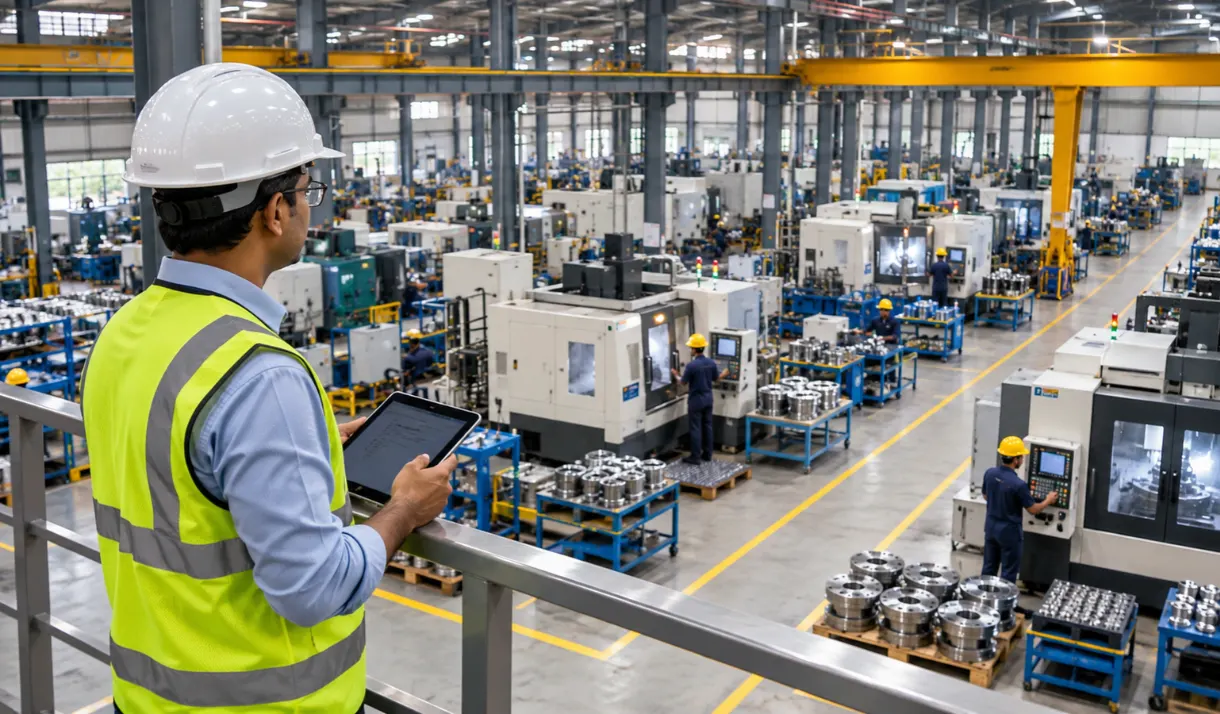

At first, the production plan looks achievable.
Materials appear available. Production orders are released. Delivery commitments have been shared with customers.
Later a critical purchased component gets delayed, one subcontracted operation is running behind schedule, and two jobs are competing for the same machine. Suddenly, a production order that looked on track is now at risk.
This is a familiar situation in many factories. The problem is often not the production schedule itself.
The problem is that a schedule only reflects what should happen. Whether production can
actually proceed depends on material availability, machine capacity, supplier performance,
subcontracting progress, and dozens of interconnected decisions happening across the
business.
This is where Production Planning and Control (PPC) becomes critical.
PPC is not simply about scheduling production orders. It is about ensuring that materials, capacity, procurement, production activities, and delivery commitments remain aligned throughout the manufacturing process.
What Does Production Planning and Control Mean?
Production planning and control (PPC) determines what needs to be produced, what
materials and resources are required, when production should take place, and whether
execution is progressing as planned.
Production planning considers:
• customer requirements and delivery dates,
• production quantities,
• bill of materials (BOM),
• material availability,
• machine and work-centre capacity,
• routing and production time, and
• procurement, internal manufacturing and subcontracting requirements.
Production control monitors what happens once the plan moves into execution.
Planning asks: What should happen?
Control asks: Is it happening as planned and if not, what has changed?
A typical flow may look like this: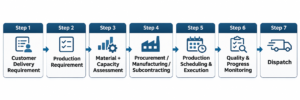
Why a Production Schedule Alone Is Not Enough
Suppose a manufacturer needs to complete 50 assemblies by Friday.
The required machine may have enough capacity, but one critical component could still be under procurement. Another part may be with a subcontractor. Material in Stores may also be reserved for another production order.
The schedule may show that production can begin today, while the actual manufacturing
situation says otherwise.
Production planning must therefore determine whether the materials, capacity and
supporting processes required for an order will actually be available when needed.
A production date is not just a scheduling decision. It is the result of several connected planning decisions.
Balancing Material, Capacity and Delivery
Effective production planning depends on three closely connected areas:
| Area | Key Question |
|---|---|
| Material | Do we have what production needs? |
| Capacity | Can we produce it within the available time? |
| Delivery | Can the order be completed when promised? |
A change in one area can quickly affect the others.
A material delay may push production into a later machine slot. A capacity constraint may
change the production sequence. A production delay may then affect quality clearance and dispatch.
This is why production planning must consider the complete manufacturing flow, not just planned start and completion dates.
Material Availability Is More Than Stock on Hand
Production planning begins with the BOM, but knowing the requirement is only the first step.
The planner also needs to know whether each component is:
• available in stock,
• allocated to another production order,
• under procurement,
• to be manufactured internally, or
• to be subcontracted.
Physical stock and available stock are not always the same thing.
A component may exist in Stores but already be reserved for another machine order. Using it for the current job could simply create a shortage elsewhere.
New Horizon ERP’s AutoShop MRP brings together material requirements, stock availability and purchase or production requirements to help identify shortages and determine whether they should be fulfilled through procurement, internal manufacturing or subcontracting.
Material Availability Does Not Mean Capacity Is Available
The opposite can also happen.
All required material may be ready, but the required machine or work centre may already be occupied.
For example, two production orders may have complete material availability but require the same CNC machine during the same shift.
Capacity planning therefore needs to consider machine availability, work-centre load, routing, production time, current commitments and order priority.
The question is not simply whether a job can be produced. It is when it can realistically be
produced without disrupting other commitments.
Material planning and capacity planning therefore need to work together.
Production Planning Requires Cross-Functional Coordination
Production planning cannot happen effectively when every department works from a different version of the requirement.
Supplier Delay → Material Shortage → Production Delay → Quality Delay → Dispatch Delay Procurement may know a component is delayed. Stores may know what is physically available.
Production may know which job is waiting. Dispatch may know the customer commitment.
The challenge is bringing this information together early enough to influence the production plan.
Effective production planning and control requires coordination between planning,
procurement, Stores, production, subcontracting, quality and dispatch.
When these functions work from disconnected information, problems may only become visible after they have already affected production or delivery.
Production Control: Keeping the Plan on Track
Even a well-prepared production plan can change during execution. A machine may break down. A supplier may miss a committed date. Actual material consumption may be higher than expected.
Production control helps manufacturers compare the plan with actual shop-floor activity:
Plan → Execute → Monitor → Adjust
It helps answer:
• Is production progressing as expected?
• Is additional material required?
• Are operations following the planned routing?
• Is the expected completion date still achievable?
New Horizon ERP supports routing-card-based production booking, daily production
reporting and supplementary material requisitions, helping connect planned requirements
with actual production activity.
Connecting Production Planning With Shop-Floor Execution
SourcePro New Horizon ERP’s AutoShop MRP connects material requirements with available stock, purchase requirements and production needs.
It helps planners determine:
• what can be produced with available material,
• which shortages require procurement,
• what needs internal manufacturing,
• which requirements need subcontracting, and
• what actions are required to support the delivery commitment.
AutoShop MRP also supports production planning, procurement planning and dispatch planning, helping manufacturers connect customer delivery requirements with the activities needed to fulfil them.
Final Thoughts
Effective production planning and control comes down to three questions:
Do we have the material?
Do we have the capacity?
Can we still meet the delivery commitment?
When material planning, capacity, procurement, production and dispatch are coordinated
around the same requirement, manufacturers gain clearer visibility into what can realistically be produced and when.
A production schedule tells you when an order should be completed. Production planning determines whether that date is achievable. Production control tells you whether
execution is still on track.