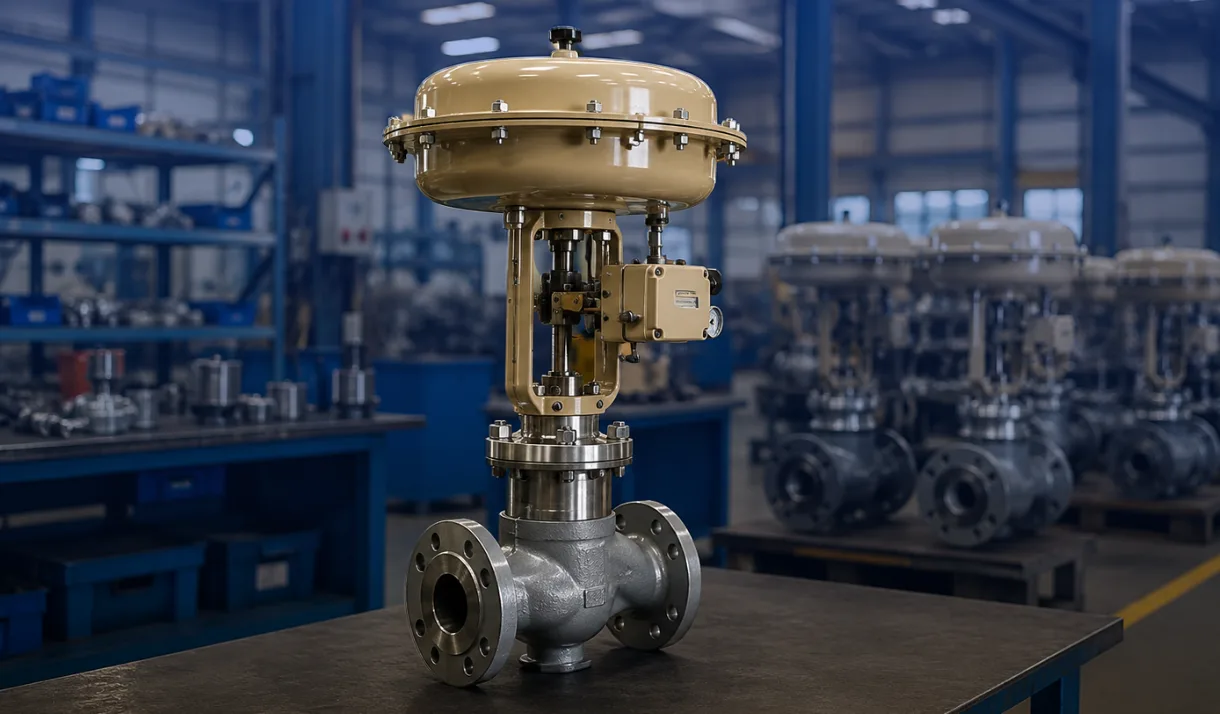

Every industry that moves liquid needs a valve to control it.
Chemical plants, pharma units, dairy processors, oil refineries, perfume manufacturers, water treatment facilities – the industries are unrelated, but the requirement is the same. Something has to control how liquid flows, when it flows, and how much of it flows.
That “something” is a valve.
Broadly, valves may be manually operated or automatically controlled. While manual valves depend on human operation, control valves regulate process conditions based on specific operating requirements.
And this is where manufacturing complexity begins. A control valve is not simply selected by size. It is defined by a combination of parameters.
Why Control Valves Are So Complex to Manufacture
A control valve is defined by parameters such as pressure, temperature, flow rate, speed of opening and closing, size, and material. On paper, that looks like a specification sheet. In practice, every parameter can influence the final valve configuration.
Pressure alone can range from 0.1 bar to 10,000 bar. That’s over a million possible values before any other parameter is even considered. Add temperature, material, diameter, and response speed, and the number of possible valve configurations explodes into the millions.
Material choice isn’t just about the valve body either. Every liquid behaves differently depending on what it touches. Certain corrosive or high-temperature applications may require specialized internal materials, linings, or coatings such as PTFE. Get the coating or material wrong, and the valve fails in the field, not in testing.
On top of this, every manufacturer has a ceiling. A company that makes valves up to a certain diameter simply cannot take on a requirement beyond that range. So before any design work starts, manufacturers have to answer a more basic question: can we even make this valve?
The Contract Review Problem
This is where most valve manufacturers get stuck.
Customers send a requirement list containing every parameter the valve needs to meet. Before quoting or accepting the order, the manufacturer has to check this list against what they’re capable of producing. This step is called contract review, and it sounds straightforward, until you look at how it actually happens on the ground.
The production team, who understands manufacturing capability best, often doesn’t have visibility into the requirement list. And when the review is done manually, it isn’t reliable. A missed parameter or an incorrectly matched material spec doesn’t show up as an error on paper, it shows up as a failed valve after installation.
Too Many BOMs, Too Little Alignment
Valve manufacturing doesn’t run on a single BOM.
- A sales-level BOM may represent what is being offered commercially.
- A customer-specific BOM may reflect the agreed requirement.
- A Master BOM may provide the standard engineering and manufacturing structure.
Each of these needs to align with the final quotation to produce one accurate, techno-commercial BOM. When they don’t align, sales promises something engineering can’t build to the same spec, or engineering builds to a spec that doesn’t match what was quoted.
Adding to this, every valve carries a TAG number which is the identifier that tells you exactly where that specific valve gets installed in the client’s plant. Sales orders, delivery challans, and quotations are all built around this tag. Get the tag logic wrong, and the wrong valve can end up mapped to the wrong location on a customer’s site.
Where Configuration Complexity Gets Solved
With millions of possible parameter combinations, a manufacturer’s item code logic has to be comprehensive and easily customizable. A rigid, generic coding structure simply cannot keep up.
And once a configuration is defined, the next question is commercial: Can this valve be built, and at what price?
In control valve manufacturing, that answer is rarely static. Selections are not independent. One parameter can determine which options are valid next, making both product configuration and quotation a dependency-driven process.
SourcePro Manufacturing ERP addresses these two challenges through its Item Code Configurator (iConfig) and Quotation Configurator.
iConfig helps identify existing configurations and generate standardized item codes, allowing engineering knowledge from past orders to be reused instead of recreated.
The Quotation Configurator guides the dependency-driven selection process step by step, narrowing the available options based on previous selections to support manufacturability and commercial evaluation.
[See how SourcePro handles configurable valve manufacturing →]
The Bigger Picture
Control valve manufacturing looks like a mechanical engineering problem from the outside. In reality, it’s also a data problem.
Millions of parameter combinations, multiple BOMs that all need to agree with each other, and a contract review process that depends on information reaching the right team at the right time.
Manufacturers who rely on manual requirement lists and disconnected BOMs aren’t just working harder than they need to. They’re carrying risk that shows up much later- maybe in a failed contract review, a mismatched TAG NO, or a valve built to a spec no one double-checked.
A system designed for configurable manufacturing does not remove that complexity. It gives the complexity structure. Parameters become searchable. Configurations become reusable. BOMs become connected. Quotation logic becomes repeatable. And engineering knowledge that once existed across documents and individual experience becomes part of the system.
Because in control valve manufacturing, the challenge is not simply making one complex valve. It is being able to manage the next thousand configurations with the same accuracy, traceability, and confidence.