

A single manufacturing job can involve multiple BOMs and thousands of individual components.
Some material may already be available in stock. Some may be reserved for another job, under procurement, waiting for quality clearance, or moving through subcontracting.
The challenge is not simply knowing what a job requires. It is knowing where that material currently stands and what action is required next.
This is where MRP becomes part of the wider manufacturing ERP.
The real question is not only “What material do we need?” but “Where is that material right now, and what action is required?”
What Does MRP Do in Manufacturing?
MRP, or Material Requirements Planning, calculates material
requirements against manufacturing demand.
Within an ERP, the planning flow broadly looks like this:
Demand → BOM → Material Availability → Requirement → Action
Demand tells the system what needs to be produced, while the Bill of Materials defines the raw materials, components and sub-assemblies required.
The ERP then brings in information from inventory, procurement, quality and production to determine what is genuinely available and what still needs attention.
That is what turns a BOM requirement into an actual material plan.
One Job Can Mean Thousands of Material Decisions
For a complex machine or engineered product, one job may involve several BOMs containing hundreds or thousands of components across different levels.
Exploding the BOM tells the planner what is required, but that is only the starting point. For every component, the ERP also needs to understand its current position.
|
Material Position |
What It Means for Planning |
|
Available in stock |
Can potentially be allocated to the job |
|
Reserved / allocated |
Already committed elsewhere |
|
Material requested |
Already moving through an internal process |
|
Under procurement |
Expected from a supplier |
|
GRN / quality stage |
Received, but not yet cleared for use |
|
Subcontracting / third party |
Still outside the plant process |
When the same assessment has to happen across thousands of components and multiple BOM levels, material planning becomes a large-scale coordination exercise rather than a simple stock check.
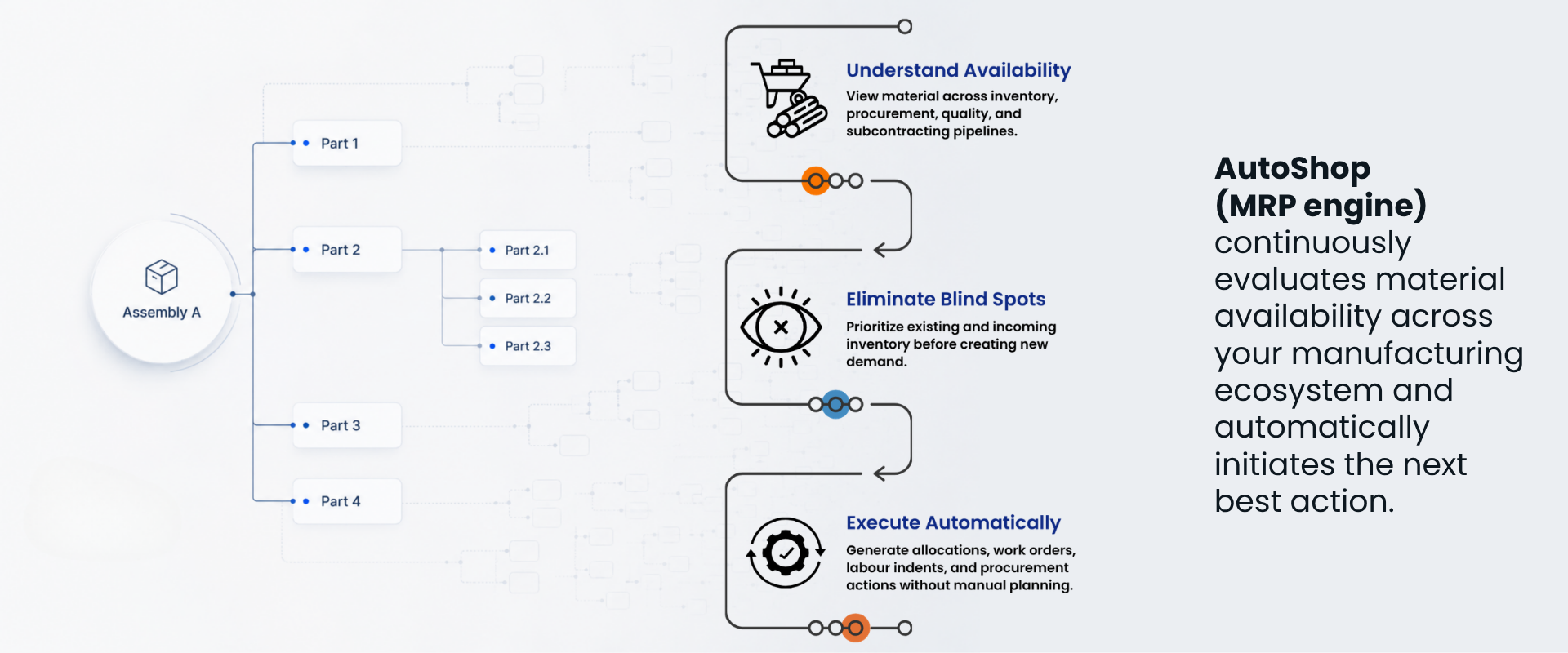
AutoShop helps evaluate material availability across inventory, procurement, quality and subcontracting before determining the appropriate planning action.
The visual captures the three key parts of the process: understand availability, eliminate blind spots, and execute the appropriate action.
Available Stock Is Only Part of the Picture
Suppose the ERP shows 100 units of a component in stock.
That does not necessarily mean all 100 units can be used for the current job. A portion may already be reserved for another production order.
At the same time, further quantities may already be entering the business through an open Purchase Order or may be waiting for quality clearance.
So the useful planning question is not simply:
“How much stock do we have?”
It is:
“How much can actually be used for this job?”
This distinction becomes especially important when several production orders are competing for the same material.
A stock balance therefore represents only one part of the material position. Planning requires visibility into both current availability and existing commitments.
From Requirement to Planning Action
Once the material position is understood, the next question is what action should follow.
Consider a production requirement for 20 bearings.
Six bearings may be physically available, but four are already committed to another job. Another eight are expected against a Purchase Order, while two have reached the plant but are still moving through the GRN and quality process.
The ERP therefore has to evaluate more than the warehouse quantity. It needs to account for usable stock, existing commitments, incoming material and material progressing through quality.
Only after understanding that position can the remaining requirement be determined.
Depending on the result, the next action may be to:
- allocate available stock,
- rely on material already in the procurement pipeline,
- create a new procurement requirement,
- manufacture the component internally, or
- route the requirement through subcontracting.
This is where MRP moves from calculating requirements to driving the next step in the manufacturing workflow.
Material Planning Changes as Manufacturing Changes
A material plan is not static.
A supplier delivery may be delayed, a batch may fail quality inspection, or a higher-priority order may suddenly require the same component.
Because these changes happen across different functions, material planning needs information from the same system that manages purchasing, inventory, production and quality.
SourcePro’s New Horizon Enterprise connects these processes within the manufacturing ERP.
Its Planning Module, powered by the AutoShop planning engine, evaluates BOM requirements against material availability, commitments and incoming supply.
This helps planners determine whether to use available stock, wait for expected material, initiate procurement, plan internal production or route a requirement through subcontracting.
The objective is not simply to produce a shortage report.
It is to convert the material requirement into the appropriate manufacturing action.
Final Thoughts
MRP in manufacturing is much more than:
BOM Requirement – Stock = Shortage
A real manufacturing job may involve multiple BOMs, thousands of components, reserved inventory, incoming purchases, quality stages and third-party processing.
The value of MRP comes from bringing those moving pieces together and turning them into a practical material plan.
The BOM tells you what is required.
The ERP shows where the material currently stands.
MRP helps determine the appropriate action.
That is how material planning becomes part of the complete manufacturing process rather than just another calculation.