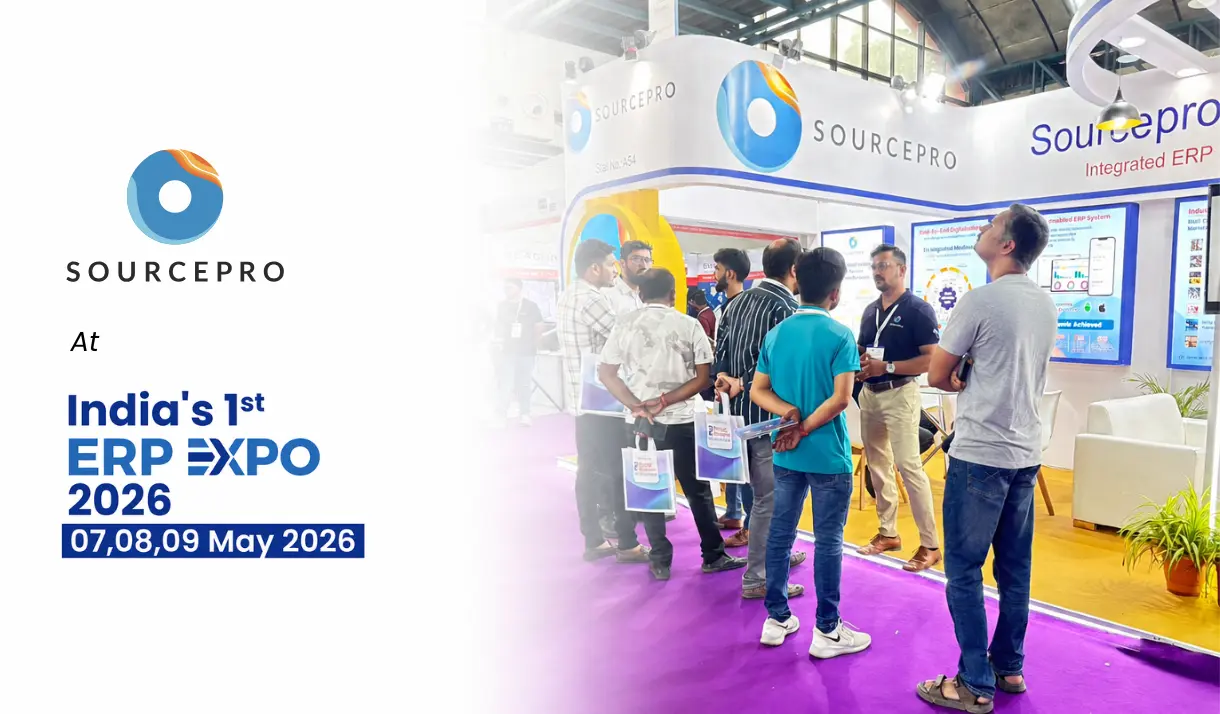

Top 10 ERP Software in India (2026 Updated List)
Choosing an ERP in 2026 isn’t just about comparing features and price anymore. Today it also means checking AI capabilities, cloud access, GST and e-invoicing compliance, and manufacturing fit — because the right ERP can transform how you handle inventory, production, finance, and customer service, while the wrong one locks in inefficiency for years.
The market is moving fast. SAP, Oracle, and Microsoft Dynamics 365 are adding AI-powered automation and predictive analytics, while manufacturing-focused platforms like SourcePro ERP are built specifically for how Indian shop floors actually work. With India’s manufacturing sector expanding rapidly, a modern ERP has gone from optional upgrade to essential investment.
This guide compares the 10 best ERP software solutions in India for 2026 — pricing (where publicly available), features, AI capabilities, and industry fit — so you can find the right one whether you’re a manufacturer, distributor, retailer, or growing SME.
What is ERP Software?
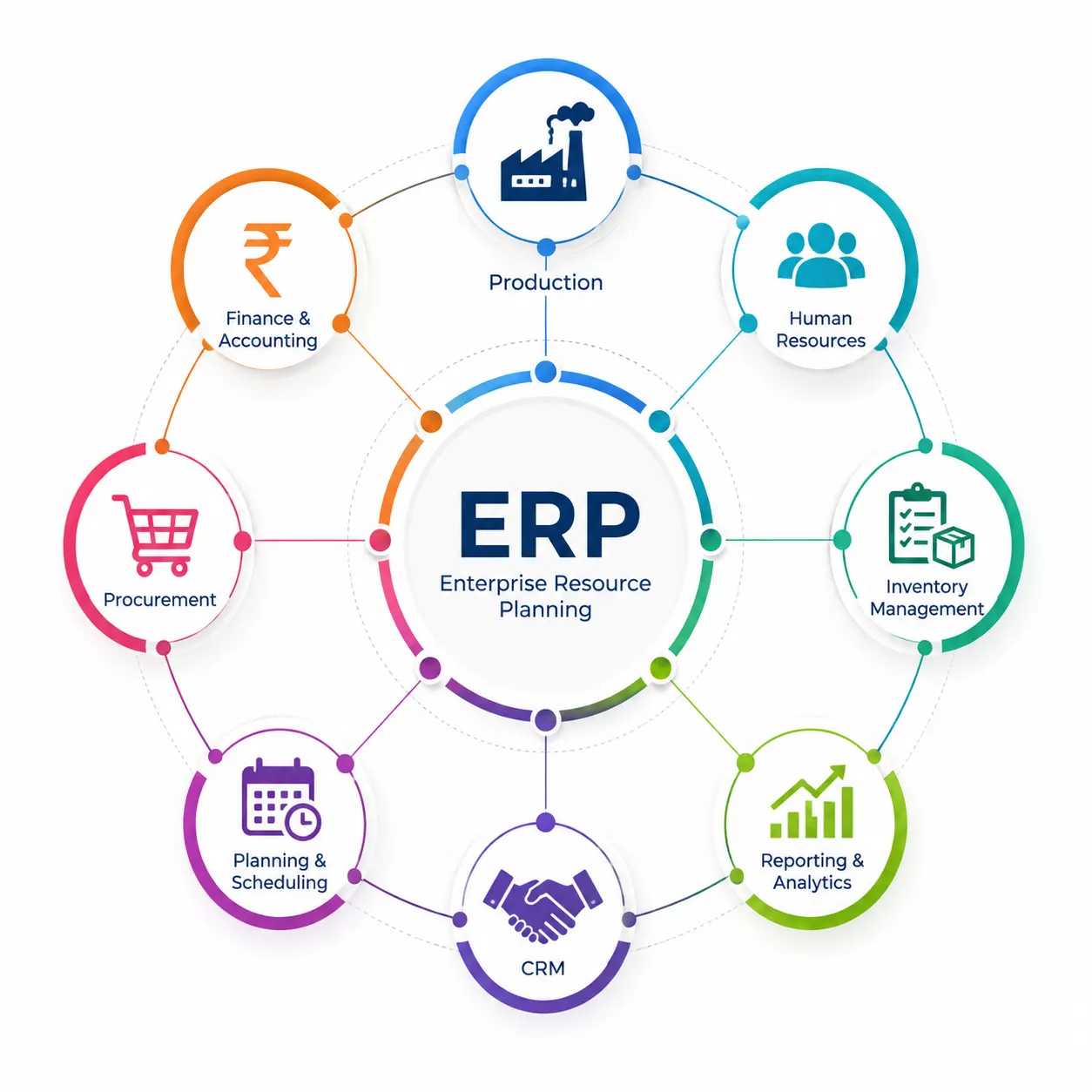
Enterprise Resource Planning (ERP) software is a business management solution that integrates multiple departments—including finance, procurement, inventory, production, sales, human resources (HR), customer relationship management (CRM), and customer service—into a single centralized system. Instead of managing data across multiple spreadsheets or disconnected applications, ERP enables every department to access real-time information from one unified database.
For example, when a customer places a new order, the ERP system automatically updates inventory levels, triggers production planning, informs the procurement team if raw materials are running low, and records the financial transaction. This seamless flow of information reduces manual work, minimizes errors, and helps businesses make faster, data-driven decisions.
For Indian businesses, especially manufacturing companies, modern ERP software also simplifies compliance by supporting GST invoicing, e-way bills, TDS, payroll, and other statutory requirements. This helps finance and operations teams stay compliant while reducing repetitive manual tasks.
Types of ERP Software
Before comparing the best ERP software in India, it’s important to understand the major types of ERP solutions available:
Discrete Manufacturing ERP

Process Manufacturing ERP
Cloud ERP (SaaS ERP)
On-Premise ERP
Two-Tier ERP
Why Understanding ERP Matters
Selecting the right ERP solution isn’t just about choosing software—it’s about finding a platform that matches your business processes, industry requirements, growth plans, and budget. Whether you’re a small business, a growing SME, or a large manufacturing enterprise, understanding these ERP categories will help you evaluate the software solutions compared in this guide and choose the one that best fits your operational needs.
| ERP | Best For | Deployment | AI | Pricing |
|---|---|---|---|---|
| SourcePro | Manufacturing | Cloud + On-Premise | Yes | Custom |
| SAP | Enterprise | Cloud | Joule AI | Quote |
| Oracle | Large Businesses | Cloud | Oracle AI | Quote |
| Dynamics | Microsoft Users | Cloud | Copilot | Quote |
| Zoho | SMEs | Cloud | Zia | Subscription |
How We Evaluated These ERP Software Solutions
Choosing the right ERP software isn’t only about selecting the vendor with the longest feature list. Every business has different operational requirements, budgets, implementation timelines, and growth plans. To make this comparison practical, we evaluated every ERP solution using the same set of business-focused criteria.
Our evaluation considered:
- Manufacturing capabilities and production planning
- Inventory and warehouse management
- Financial management and accounting
- GST, e-Invoicing, and statutory compliance for Indian businesses
- Artificial Intelligence (AI) capabilities
- Ease of implementation
- Cloud and On-Premise deployment options
- Scalability for future growth
- Integration with third-party applications
- Customer support and partner ecosystem
- Pricing transparency and overall value
Instead of ranking software purely by popularity, this guide focuses on helping Indian businesses identify the ERP solution that best fits their operational needs, industry, and long-term growth strategy.
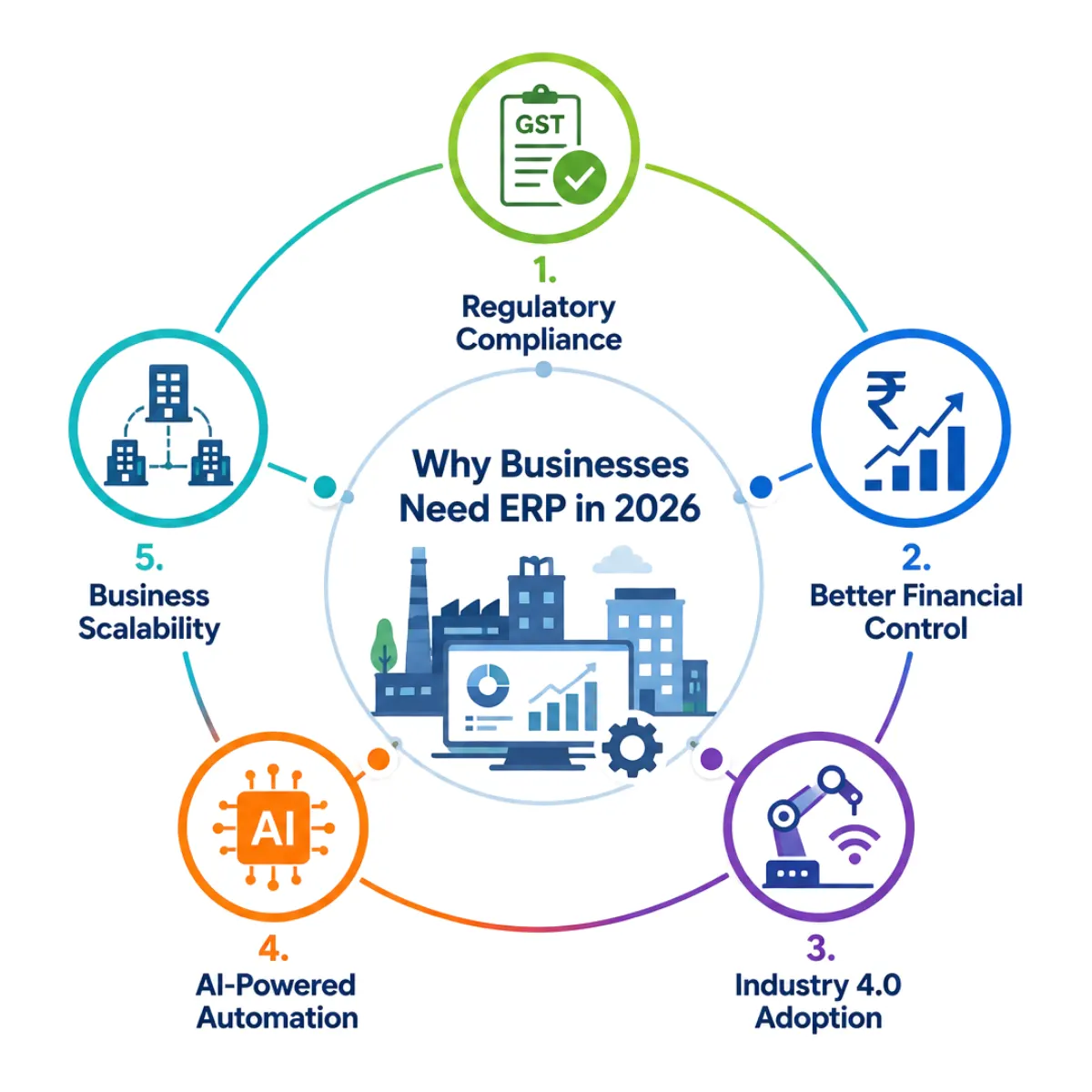
Why Businesses Need ERP in 2026
In 2026, ERP software has evolved from being a back-office management tool to a strategic business solution. As Indian businesses embrace digital transformation, modern ERP systems help streamline operations, improve productivity, and provide real-time visibility across finance, inventory, production, sales, and human resources.
Several factors are driving ERP adoption across industries:
Regulatory Compliance: Automates GST, e-invoicing, e-way bills, TDS/TCS, and payroll compliance.
Better Financial Control: Provides real-time insights into cash flow, inventory, and working capital.
Industry 4.0 Adoption: Integrates manufacturing processes with IoT, MES, and smart factory technologies.
AI-Powered Automation: Enables predictive analytics, demand forecasting, automated reporting, and intelligent decision-making.
Business Scalability: Supports growing businesses by connecting multiple departments, locations, and users on a single platform.
Whether you’re a manufacturing company, distributor, retailer, or growing SME, investing in the right ERP software helps improve efficiency, reduce operational costs, ensure compliance, and stay competitive in an increasingly digital business environment.
ERP Statistics
The ERP market continues to grow as businesses invest in cloud technology, AI, and digital transformation. Here are some of the latest ERP statistics for 2026:
The global ERP software market is estimated to exceed $80 billion in 2026 and is expected to grow steadily over the next decade.
Cloud ERP now accounts for more than 50% of new ERP deployments worldwide, making it the preferred deployment model for most businesses.
The manufacturing sector remains one of the largest adopters of ERP software due to increasing automation and Industry 4.0 initiatives.
The Indian ERP market is projected to grow at a 13–16% CAGR, driven by digital transformation across manufacturing, retail, healthcare, and logistics.
Nearly 70% of new ERP implementations in India are cloud-based, reflecting the growing demand for scalable and cost-effective solutions.
SMEs are the fastest-growing ERP users in India as businesses seek better inventory management, financial control, and regulatory compliance.
Organizations implementing ERP typically achieve a positive return on investment (ROI) within 2–3 years, with significant improvements in operational efficiency and cost savings.
AI-powered ERP is becoming the industry standard, with leading vendors such as SAP, Oracle, and Microsoft integrating intelligent automation, predictive analytics, and AI assistants into their platforms.
ERP Market Trends in India (2026)
The ERP industry is evolving rapidly as businesses increasingly adopt digital transformation initiatives. Some of the most significant trends shaping ERP adoption in 2026 include:
AI-Driven ERP
Artificial intelligence is now integrated into leading ERP platforms, enabling predictive analytics, automated reporting, intelligent demand forecasting, and AI assistants that help employees complete routine tasks faster.
Cloud-First Adoption
Cloud ERP continues to dominate new implementations because it offers lower upfront investment, automatic software updates, improved security, and remote accessibility.
Industry-Specific ERP
Rather than choosing generic ERP systems, businesses increasingly prefer industry-specific ERP solutions tailored to sectors such as machinery and equipment, automotive components, engineering, food processing, chemicals, and other specialized manufacturing environments.
Mobile ERP
Modern ERP systems now provide mobile applications allowing managers to monitor production, inventory, sales, and financial reports from anywhere.
Industry 4.0 Integration
Manufacturers are integrating ERP with IoT devices, smart machines, MES systems, barcode scanners, RFID, and automated production equipment to create intelligent factories.
How to Choose the Right ERP Software
Selecting ERP software is a long-term business decision. Instead of focusing only on software popularity, businesses should evaluate how well the ERP aligns with their operational processes and future growth plans.
Consider the following factors before choosing an ERP solution:
Industry Compatibility
Manufacturing companies require production planning, MRP, BOM management, quality control, and machine integration, whereas retailers prioritize POS, inventory, and omnichannel sales.
Business Size
Startups often require affordable cloud ERP systems, while mid-sized businesses need scalable platforms capable of supporting multiple locations and departments.
Budget
Calculate not only software licensing costs but also implementation, customization, training, maintenance, and support expenses.
Scalability
Choose software capable of supporting additional users, plants, warehouses, and business units without requiring complete replacement in the future.
AI Features
Modern ERP systems should include predictive analytics, intelligent reporting, workflow automation, and AI-powered business insights.
Customer Support
Implementation success often depends more on the implementation partner than the software itself.
Top 10 ERP Software
1. SourcePro ERP – Best Manufacturing ERP Software in India
Overview:
SourcePro ERP is a comprehensive manufacturing-focused ERP solution built for Indian manufacturers, from growing manufacturing businesses to complex multi-plant enterprises. It helps manufacturers streamline production planning, inventory management, procurement, finance, quality control, CRM, HR, and after-sales service from a single platform. Built with Indian business requirements in mind, it also supports GST, e-Invoicing, e-Way Bills, and statutory compliance, making it an ideal choice for businesses looking to improve operational efficiency and scalability.
Key Features:
- production planning & Material Requirement Planning (MRP)
- Inventory & Warehouse Management
- Procurement & Purchase Management
- Finance & Accounting
- Quality control
- CRM & Sales Management
- HR & Payroll
- GST & Statutory Compliance
- Cloud & On-Premise Deployment
Pros:
- Built specifically for Indian manufacturing businesses
- Faster implementation compared to many global ERP solutions
- Modular and scalable based on business requirements
- Strong local implementation and customer support
Cons:
- Primarily focused on manufacturing industries
- Smaller global presence than SAP or Oracle
Whether you’re a small manufacturing unit or a multi-plant enterprise, SourcePro ERP provides the flexibility, automation, and real-time visibility needed to optimize operations and support business growth.
2. SAP S/4HANA & SAP Business One – Best ERP for Large Enterprises
Overview:
SAP S/4HANA and SAP Business One are among the world’s leading ERP solutions, trusted by large enterprises and growing businesses across manufacturing, retail, automotive , and logistics. SAP S/4HANA is ideal for large organizations with complex operations, while SAP Business One is designed for SMEs looking for enterprise-grade capabilities at a lower cost. Both solutions offer advanced finance, supply chain, manufacturing, analytics, and AI-powered automation.
Key Features:
- Finance & Accounting Management
- Supply Chain & Procurement
- Manufacturing & production planning
- Inventory & Warehouse Management
- Business Intelligence & Analytics
- AI-Powered Business Automation
- Multi-Currency & Multi-Country Support
- Cloud, On-Premise & Hybrid Deployment
Pros:
- Comprehensive ERP with extensive modules
- Excellent for global and multi-location businesses
- Strong analytics and AI capabilities
- Large implementation partner ecosystem
Cons:
- Higher implementation and licensing costs
- Longer deployment time compared to SME-focused ERP solution
3. Oracle NetSuite & Oracle Fusion Cloud ERP – Best Cloud ERP for Growing Businesses
Overview:
Oracle NetSuite and Oracle Fusion Cloud ERP are powerful cloud-based ERP solutions designed for fast-growing businesses and large enterprises. They help organizations manage finance, inventory, procurement, CRM, supply chain, and business operations from a single platform. With AI-powered automation, real-time analytics, and multi-entity management, Oracle ERP is an excellent choice for companies planning to scale globally.
Key Features:
- Financial Management & Accounting
- Inventory & Order Management
- Procurement & Supply Chain Management
- CRM & Customer Management
- AI-Powered Analytics & Reporting
- Multi-Company & Multi-Currency Support
- Cloud-Based Deployment
- Third-Party Integrations
Pros:
- Strong cloud-first ERP platform
- Excellent real-time reporting and analytics
- Ideal for multi-location and global businesses
- AI-powered automation and workflow management
Cons:
- Higher pricing compared to many SME-focused ERP solutions
- Some India-specific compliance features may require local customization
4. Microsoft Dynamics 365 – Best ERP for Microsoft Ecosystem Businesses
Overview:
Microsoft Dynamics 365 combines ERP and CRM capabilities into a unified business management platform. It is ideal for businesses already using Microsoft 365, Teams, Azure, and Power BI, offering seamless integration across finance, supply chain, manufacturing, sales, HR, and project management. With Microsoft’s Copilot AI, businesses can automate routine tasks, generate insights, and improve decision-making through AI-powered assistance.
Key Features:
- Finance & Accounting Management
- Supply Chain & Inventory Management
- Manufacturing & production planning
- CRM & Sales Management
- Project Operations
- HR & Payroll
- Microsoft Copilot AI
- Power BI Analytics & Reporting
- Cloud & On-Premise Deployment
Pros:
- Seamless integration with Microsoft 365, Teams, and Power BI
- AI-powered Copilot for improved productivity
- Flexible deployment options
- Highly scalable for growing businesses
Cons:
- Advanced manufacturing features may require third-party add-ons
- Licensing and implementation costs can be high for smaller businesses
5. Zoho One – Best ERP for Small & Medium Businesses
Overview:
Zoho One is a cloud-based business management suite designed for small and medium-sized businesses looking for an affordable ERP solution. It brings together finance, CRM, inventory, HR, project management, analytics, and collaboration tools into a single platform. With the built-in Zia AI assistant and seamless integration across 45+ business applications, Zoho One is an excellent choice for businesses seeking a scalable and cost-effective cloud ERP.
Key Features:
- Finance & Accounting
- CRM & Sales Automation
- Inventory Management
- HR & Payroll
- Project Management
- Business Analytics
- Zia AI Assistant
- Cloud-Based Deployment
- Third-Party Integrations
Pros:
- Affordable pricing for small and growing businesses
- 45+ integrated business applications
- Easy to implement and use
- Strong CRM and business automation capabilities
Cons:
- Limited advanced manufacturing and production planning features
- Not ideal for businesses with complex shop-floor operations
6. TallyPrime – Best Accounting Software for Small Businesses
Overview:
TallyPrime is one of India’s most popular accounting and business management software solutions, widely used by micro and small businesses. It simplifies accounting, GST compliance, inventory management, payroll, and financial reporting, making it an excellent choice for businesses looking for reliable accounting software. While TallyPrime offers basic inventory and business management features, it is not a complete ERP solution for businesses with complex manufacturing or operational requirements.
Key Features:
- GST Billing & Return Filing
- Accounting & Financial Reporting
- Inventory Management
- Payroll Management
- Banking & Reconciliation
- Multi-Company Management
- Cloud & On-Premise Access
- Business Reports & Analytics
Pros:
- Easy to use with strong GST compliance
- Affordable for micro and small businesses
- Trusted by accountants and CAs across India
- Supports cloud and on-premise deployment
Cons:
- Limited manufacturing and production planning capabilities
- Lacks advanced ERP modules like CRM, MRP, and Quality control
7. ERPNext – Best Open-Source ERP for Startups & SMEs
Overview:
ERPNext is an open-source ERP solution designed for startups, SMEs, and growing businesses looking for a flexible and cost-effective business management platform. It offers modules for accounting, manufacturing, inventory, CRM, HR, payroll, project management, and asset management. With its open-source architecture, businesses can customize the system to match their workflows while avoiding per-user licensing costs.
Key Features:
- Accounting & Finance
- Manufacturing & Production Management
- Inventory & Warehouse Management
- CRM & Sales
- HR & Payroll
- Project & Asset Management
- Open-Source Customization
- Cloud & Self-Hosted Deployment
Pros:
- Free open-source core with flexible customization
- Comprehensive business management modules
- Strong community support and India compliance features
- Suitable for startups and growing SMEs
Cons:
- Requires technical expertise or an implementation partner
- Customization and ongoing maintenance can increase overall costs
8. Infor CloudSuite – Best Industry-Specific ERP for Manufacturing
Overview:
Infor CloudSuite is a cloud-based ERP solution designed for manufacturing, distribution, food & beverage, automotive , and industrial businesses. Unlike generic ERP platforms, it offers industry-specific solutions with built-in best practices, helping businesses streamline production, supply chain management, finance, and asset management. Its advanced analytics and AI-powered insights make it a strong choice for medium and large enterprises.
Key Features:
- Manufacturing & Production Management
- Supply Chain Planning
- Finance & Accounting
- Human Capital Management (HCM)
- Asset Management
- AI-Powered Analytics
- Industry-Specific ERP Solutions
- Cloud-Based Deployment
Pros:
- Industry-specific ERP tailored for manufacturing sectors
- Strong supply chain and production planning capabilities
- Scalable cloud platform with AI-driven insights
- Suitable for complex manufacturing operations
Cons:
- Smaller implementation partner network in India
- Higher implementation costs for small businesses
9. Epicor Kinetic – Best ERP for Manufacturing & Distribution
Overview:
Epicor Kinetic is a modern ERP solution built specifically for manufacturing and distribution businesses. It helps companies streamline production planning, inventory management, supply chain operations, finance, CRM, and Quality control through a single integrated platform. With its intuitive user interface, real-time analytics, and industry-specific capabilities, Epicor Kinetic is a strong choice for businesses looking to improve operational efficiency and support long-term growth.
Key Features:
- Manufacturing & Production Management
- Supply Chain & Inventory Management
- Finance & Accounting
- CRM & Customer Management
- Quality control
- Real-Time Analytics & Reporting
- Cloud, On-Premise & Hybrid Deployment
- Industry-Specific Manufacturing Solutions
Pros:
- Purpose-built for manufacturing and distribution industries
- Scalable platform that grows with your business
- User-friendly interface with powerful reporting tools
- Flexible deployment options
Cons:
- Higher implementation and licensing costs for SMEs
- May require additional customization for India-specific compliance
10. Odoo – Best Modular ERP for Growing SMEs
Overview:
Odoo is a flexible, open-source ERP platform designed for small and medium-sized businesses looking for a scalable and cost-effective business management solution. Its modular approach allows companies to start with essential applications such as accounting or inventory and add modules like manufacturing, CRM, HR, eCommerce, and project management as their business grows. With a large partner network and active community, Odoo is a popular choice for businesses seeking a customizable ERP.
Key Features:
- Accounting & Finance
- Inventory & Warehouse Management
- Manufacturing (MRP)
- CRM & Sales
- HR & Payroll
- Project Management
- eCommerce Integration
- Cloud & On-Premise Deployment
Pros:
- Affordable and modular pricing
- Highly customizable with a wide range of business apps
- Strong community and partner ecosystem
- Suitable for businesses planning gradual digital transformation
Cons:
- Advanced manufacturing features often require the Enterprise edition or partner customization
- Implementation complexity can increase as more modules are added
Which ERP Software is Best for Different Businesses?
| Business Type | Recommended ERP |
|---|---|
| Manufacturing | SourcePro ERP |
| Large Enterprise | SAP S/4HANA |
| Global Enterprise | Oracle Fusion Cloud |
| Startup | ERPNext |
| Retail Business | Zoho One |
| Distribution Company | Epicor |
| Engineering Industry | SourcePro ERP |
| Automobile Manufacturer | SAP |
| Food Processing | Infor CloudSuite |
Every business has different operational priorities. Manufacturing companies generally benefit from ERP systems with strong production planning and inventory capabilities, whereas service-based businesses may prioritize CRM and project management. Selecting software that matches your industry processes often delivers better long-term value than simply choosing the most popular ERP platform.
Cloud ERP vs On-Premise ERP
| Feature | Cloud ERP | On-Premise ERP |
|---|---|---|
| Initial Cost | Lower | Higher |
| Maintenance | Vendor | Company |
| Accessibility | Anywhere | Office Network |
| Updates | Automatic | Manual |
| Scalability | Easy | Moderate |
| Security | Vendor Managed | Internal IT |
| Implementation | Faster | Slower |
ERP Implementation Process
Implementing ERP software involves much more than installing software. A successful ERP implementation requires careful planning, employee training, and continuous optimization.
Typical ERP implementation stages include:
Business Requirement Analysis
Understand existing business processes and identify improvement opportunities.
Vendor Selection
Evaluate ERP vendors based on functionality, pricing, implementation support, and scalability.
Data Migration
Transfer customer records, inventory, accounting data, suppliers, and historical transactions.
Customization
Configure workflows, reports, dashboards, and approval processes according to business requirements.
User Training
Train employees before the system goes live.
Go-Live
Deploy ERP across departments while monitoring performance.
Continuous Improvement
Review reports, optimize workflows, and implement additional modules as business requirements evolve.
Common ERP Implementation Mistakes
Many ERP implementations fail because businesses focus only on software features while ignoring process improvement and user adoption. Avoid these common mistakes:
- Choosing ERP based only on price
- Ignoring future scalability
- Underestimating implementation time
- Poor employee training
- Incomplete data migration
- Excessive software customization
- Lack of executive involvement
- No clear implementation roadmap
Planning ahead significantly improves ERP implementation success and long-term return on investment.
ERP Buying Checklist
Before selecting an ERP solution, ensure you can answer the following questions:
✔ Does the ERP support your industry?
✔ Is GST and statutory compliance included?
✔ Can it scale with future business growth?
✔ Does it support cloud deployment?
✔ Is AI functionality available?
✔ What is the implementation timeline?
✔ Are training and customer support included?
✔ What integrations are available?
✔ What is the total cost of ownership?
✔ Can the ERP support multiple locations and warehouses?
Using this checklist will help businesses compare vendors objectively and select software that delivers long-term operational value.
Frequently Asked Questions (FAQs)
The best ERP software depends on your business size, industry, and operational requirements. Manufacturing-focused ERP solutions like SourcePro ERP are designed for production planning, inventory management, quality control, procurement, and GST compliance. Enterprise solutions such as SAP S/4HANA, Oracle NetSuite, and Microsoft Dynamics 365 are better suited for large organizations with complex operations.
ERP software pricing varies based on deployment type, number of users, modules, and customization requirements. Cloud ERP solutions generally operate on a monthly or annual subscription, while on-premise ERP involves a one-time license fee along with implementation and maintenance costs. Many vendors, including SourcePro ERP, provide custom pricing based on business needs.
Implementation timelines depend on the size and complexity of the project. Small businesses can typically implement ERP in 4–8 weeks, while medium and large enterprises may require 3–12 months for complete deployment, customization, data migration, and user training.
Cloud ERP offers lower upfront costs, automatic software updates, remote accessibility, easier scalability, and reduced IT maintenance. On-premise ERP provides greater control over infrastructure and data, making it suitable for organizations with strict security or compliance requirements.
ERP software is widely used across manufacturing, automotive, engineering, pharmaceuticals, FMCG, retail, logistics, healthcare, textiles, and distribution. Modern ERP systems help businesses improve productivity, automate workflows, enhance inventory control, and make data-driven decisions.
When evaluating ERP software, look for features such as finance and accounting, inventory management, production planning, procurement, CRM, HR & payroll, reporting and analytics, GST compliance, cloud deployment, AI-powered automation, and integration capabilities. Choosing an ERP that aligns with your business processes is more important than simply selecting the software with the most features.
Yes. SourcePro ERP is designed for Indian SMEs and mid-sized manufacturing businesses. Its modular architecture allows companies to start with the required modules and expand as they grow, making it a scalable solution for businesses planning long-term digital transformation.
Start by identifying your business goals, industry requirements, budget, and future growth plans. Compare ERP solutions based on features, implementation time, scalability, customer support, and total cost of ownership. Requesting live product demonstrations from shortlisted vendors is one of the best ways to evaluate which ERP best fits your business.
Conclusion
Choosing the best ERP software in India depends on your business size, industry, budget, and operational requirements. While enterprise solutions like SAP, Oracle, and Microsoft Dynamics 365 are ideal for large organizations, platforms such as Zoho One, Odoo, and ERPNext cater well to startups and growing SMEs.
For Indian manufacturing businesses, SourcePro ERP stands out with its industry-specific features, built-in GST compliance, faster implementation, and scalable modules designed for production, inventory, finance, and quality management. By evaluating your business needs, comparing key features, and requesting product demonstrations, you can confidently select an ERP solution that supports long-term growth and digital transformation.
Ready to transform your business?
Request a free SourcePro ERP demo today and discover how the right ERP can streamline your operations and improve productivity.