
Product costing looks straightforward on paper.
Material + labour + production overheads + other manufacturing costs = product cost.
But manufacturing rarely follows the exact assumptions used during estimation.
Material prices change.
Production takes longer than planned.
Scrap and rework appear.
Subcontracting costs vary.
Overheads accumulate differently from what was estimated.
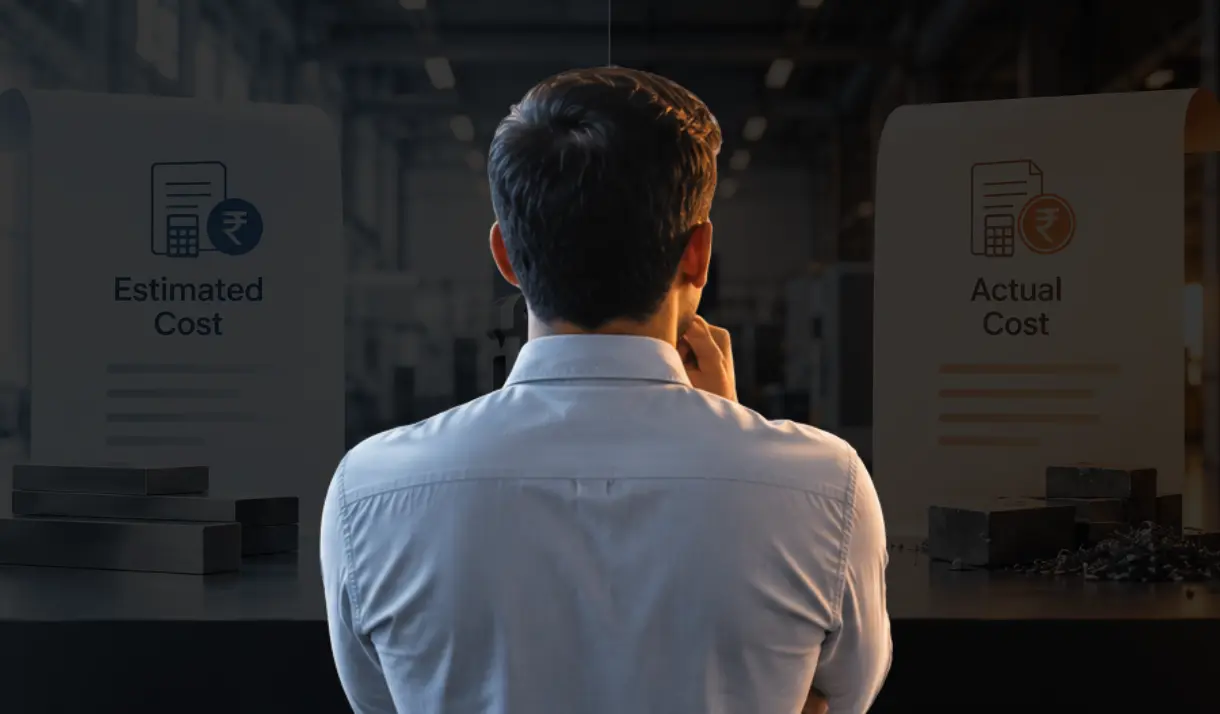
By the time the product is completed, the estimated cost and actual cost can tell two very different stories.
And if manufacturers don’t understand that difference, they may be pricing products, evaluating margins, and making production decisions using costs that were never truly achieved.
What Is Product Costing in Manufacturing?
Product costing is the process of determining the cost involved in manufacturing a product.
Depending on the manufacturing process, product cost can include:
- Raw materials and components
- Direct labour
- Production or machine time
- Subcontracting or job work
- Manufacturing overheads
- Scrap and rejection
- Other production-related costs
Before production starts, manufacturers generally work with an estimated or standard cost.
After production, they can determine the actual cost based on what was really consumed and what actually happened on the shop floor.
The two numbers serve different purposes.
Estimated cost tells you what the product should cost.
Actual cost tells you what the product did cost.
You need both.
Estimated Product Cost: What Should It Cost?
Estimated or standard product costing establishes a baseline before production.
For example, a manufacturer may estimate:
| Cost Component | Estimated Cost |
| Material | ₹48,000 |
| Labour | ₹12,000 |
| Processing | ₹8,000 |
| Subcontracting | ₹5,000 |
| Overheads | ₹7,000 |
| Estimated Product Cost | ₹80,000 |
This estimate can help manufacturers:
- Prepare quotations
- Set selling prices
- Estimate margins
- Compare product economics
- Evaluate whether an order is commercially viable
But the estimate is based on assumptions.
The shop floor is where those assumptions are tested.
Actual Product Cost: What Did It Really Cost?
Actual product costing looks at what happened during production.
The actual cost can differ from the estimate because production rarely follows every assumption perfectly.
- Material rates can change.
- More material may be consumed.
- Production may take longer.
- Rejections may occur.
- Additional material may be required.
- A job may require rework or additional processing.
- Subcontracting costs may change.
So the same product estimated at ₹80,000 may eventually cost ₹87,500.
The ₹7,500 difference is called a cost variance.
But knowing the variance alone isn’t enough. The real value comes from understanding what caused it. e all built around this tag. Get the tag logic wrong, and the wrong valve can end up mapped to the wrong location on a customer’s site.
Why Track Both Estimated and Actual Cost?
Tracking only estimated cost tells you what you expected. Tracking only actual cost tells you what happened.
Tracking both lets you understand the gap between the two, so that you can reduce it.
That comparison helps manufacturers answer important questions:
- Were our original costing assumptions accurate?
- Did material cost more than expected?
- Did production consume more material?
- Did the job take longer than planned?
- Where did the additional cost come from?
- Should the standard cost be revised?
- Are future quotations based on realistic numbers?
This is particularly important when manufacturing involves changing input prices, customised production, job work, multiple operations, and tight delivery commitments.
In practical manufacturing terms, cost differences often become visible through three broad areas:
RATE: Material, supplier, job-work, or processing rates changed.
QUANTITY: More material was consumed due to scrap, rejection, rework, or additional requirements.
ACTIVITY: Production took longer due to downtime, rework, changeovers, or additional operations.
How a Manufacturing ERP Can Shorten the Gap
Material movement, production quantities, time booking, additional material, returns and rejections all contribute to understanding actual production cost.
Instead of keeping estimated costing in one place and actual production information somewhere else, an integrated system can connect the two.
The flow becomes:
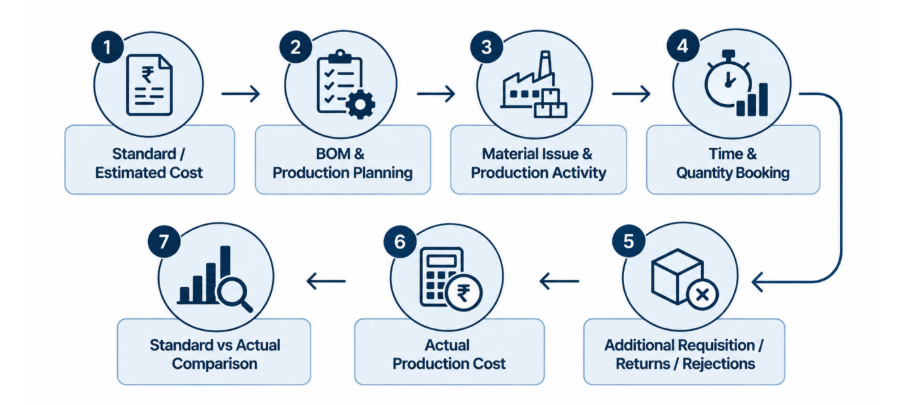
SourcePro’s Production Module supports Actual & Standard Production Costing, along with:
- Real-time shop-floor tracking
- Time and quantity booking
- Extra requisitions
- Returns
- Extra rejection handling
The objective isn’t simply to produce a final cost figure.
It is to create visibility into how the final cost was reached.
Final Thoughts
Product costing is not just about knowing what a product should cost.
It is about knowing what it actually costs and understanding why the two numbers differ.
Estimated cost gives you the baseline.
Actual cost gives you the reality.
The variance tells you where to look.
When manufacturers track all three factors, rate, quantity, and activity, product costing becomes more than just a calculation.
It becomes a way to make future estimates, quotations, production decisions, and margins more accurate.