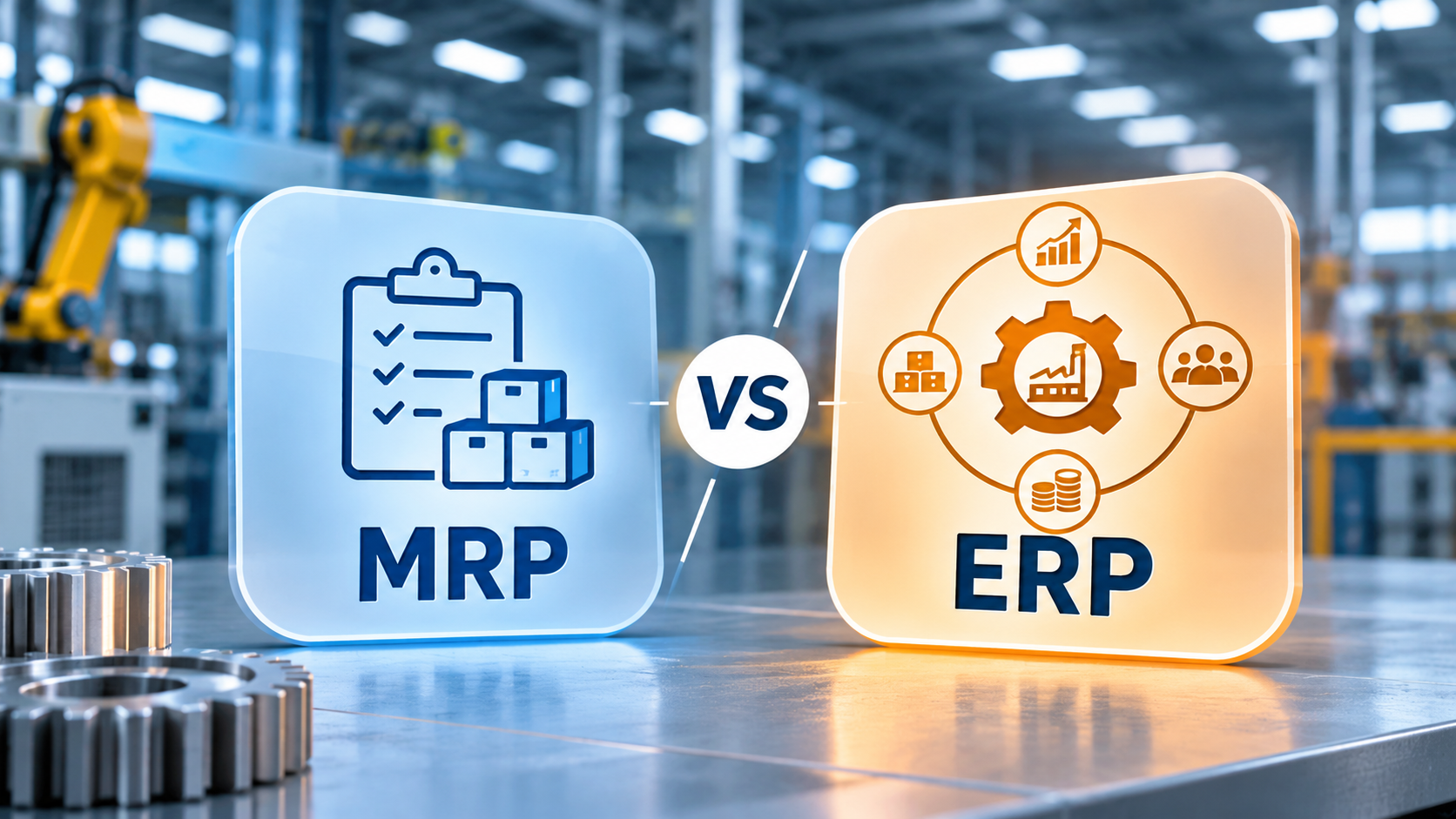

The main difference between ERP and MRP is that Material Requirements Planning (MRP) determines what materials are needed, in what quantities and when, while Enterprise Resource Planning (ERP) integrates material planning with production, procurement, inventory, quality control, finance, and other business functions.
For manufacturers dealing with material shortages, excess inventory, production delays and rising operational costs, understanding ERP vs MRP is essential to choosing software that addresses their actual business challenges.
What Is MRP in Manufacturing?
Material Requirements Planning (MRP) is a systematic approach to calculating material requirements and determining procurement and manufacturing timelines based on production demand.
MRP software for manufacturing primarily works with five inputs:
- Bill of Materials (BOM): Raw materials, components, subassemblies and quantities required to manufacture a product.
- Demand: Customer orders, sales forecasts, and production requirements.
- Inventory availability: Existing stock and quantities committed to other orders.
- Purchase pipeline: Expected material receipts against outstanding purchase orders.
- Lead times: Time required to procure or manufacture components.
Using these inputs, MRP calculates net material requirements, identifies shortages, and recommends procurement or manufacturing actions.
An MRP calculation is only as reliable as its underlying data. Even a minor quantity error in a multi-level BOM can create significant procurement discrepancies across multiple production orders.
What Is the Difference Between MRP, MRP II and ERP?
Traditional MRP focuses on material requirements. Manufacturing Resource Planning (MRP II) extends planning to additional manufacturing resources, including machinery and labour capacity. ERP broadens this scope by integrating manufacturing operations with finance, sales and other enterprise functions.
This evolution from MRP to ERP reflects the increasing ne ed for coordination beyond material planning.
What Is ERP in Manufacturing?
Enterprise Resource Planning (ERP) is an integrated software system that connects manufacturing, operational and administrative processes through a common database.
ERP software for manufacturing typically integrates:
- Material and BOM management
- Procurement and inventory management
- Production planning and execution
- Quality control and subcontracting
- Finance and production costing
- Sales and dispatch management
Consider a manufacturer receiving an engineering change after confirming a customer order. Without integration, procurement may continue purchasing against an outdated BOM while production follows revised specifications.
Manufacturing ERP software helps coordinate BOM revisions, material requirements, procurement commitments, and production schedules while providing visibility into their financial implications.
ERP vs MRP: What Are the Key Differences?
Standalone MRP primarily addresses material planning, whereas manufacturing ERP connects planning with operational execution, departmental coordination and financial management.
| Comparison Parameter | Standalone MRP | Manufacturing ERP |
| Primary purpose | Material requirements planning | Integrated business management |
| Scope | Materials and procurement planning | Manufacturing and enterprise-wide operations |
| Production planning | Primarily material-driven | Material, capacity and execution planning |
| Departmental integration | Limited or externally integrated | Cross-departmental integration |
| Costing visibility | Typically material-focused | Material, labour, overhead and WIP costing |
| Subcontracting | Depends on software capabilities | Can integrate job work, inventory and costing |
| Implementation | Generally narrower in scope | Broader process mapping and training |
| Scalability | Focused planning requirements | Growing operational and organisational complexity |
| Best suited for | Businesses requiring material planning | Businesses requiring integrated operational control |
Which Is Better for Manufacturing Businesses: ERP or MRP?
Standalone MRP may be sufficient when a manufacturer has straightforward product structures, reliable inventory records and limited departmental dependencies. ERP becomes more relevant when operational challenges extend beyond material planning.
The following framework can help manufacturers evaluate their requirements.
| Manufacturing Challenge | System to Consider |
| Manual material requirement calculations | MRP |
| Shortages caused by inaccurate BOMs | MRP with improved master data |
| Disconnected purchase, stores and production departments | Integrated ERP |
| Limited visibility into actual production costs | Manufacturing ERP |
| Difficulty tracking subcontracted inventory | ERP with job work management |
| Disconnected manufacturing locations | Multi-location ERP |
For Indian SMEs and MSMEs evaluating manufacturing ERP software, GST compliance, accounting integration, implementation costs and workforce readiness are additional considerations.
The decision should reflect operational complexity rather than turnover or employee count alone.
Why is SourcePro Manufacturing ERP worth considering standalone MRP software?
While standalone MRP software helps manufacturers determine material requirements, SourcePro Infotech’s New Horizon Enterprise connects material planning with the entire manufacturing lifecycle, from order booking and procurement to production, quality control, costing and dispatch.
Powered by its integrated AUTOSHOP MRP engine, New Horizon Enterprise enables manufacturers to:
- Optimize inventory investment by considering available stock, existing allocations and outstanding purchase orders before initiating fresh procurement.
- Improve planning accuracy through multi-level BOM management and order-specific material requirements.
- Streamline production execution by connecting material requirements with internal manufacturing and subcontracting activities.
- Enhance costing visibility by integrating inventory movements, material consumption and production activities with finance.
- Eliminate departmental silos through centralized information accessible across planning, purchase, stores, production and finance.
Unlike standalone MRP software, New Horizon Enterprise connects material planning with operational and financial control, helping manufacturers make informed decisions about inventory investment, production schedules, delivery commitments and profitability.
Explore SourcePro’s Planning Module to understand how integrated material requirements planning supports manufacturing operations.
Real-World Manufacturing Example: K. K. Nag
K.K. Nag Pvt. Ltd., a manufacturer of polymer automotive components and Thermocol products, faced challenges in material requirements planning, inventory visibility and production coordination across 11 manufacturing locations.
SourcePro’s New Horizon ERP integrated MRP with production planning, mould-machine-item mapping, inventory, sales and dispatch, enabling better material availability assessment and real-time operational visibility.
The implementation demonstrates how integrated ERP extends beyond standalone MRP by connecting material requirements with production resources and wider manufacturing operations.
Read the complete K. K. Nag case study
Choosing the Right System for Your Manufacturing Business
When evaluating ERP vs MRP, begin by identifying where your existing processes fall short. Review BOM accuracy, inventory commitments, procurement lead times, production schedules and actual job-wise costing.
If material planning is your primary concern, standalone MRP may be sufficient. If disconnected departments are affecting delivery commitments, working capital and profitability, an integrated ERP system deserves consideration.
Explore New Horizon Enterprise or request a personalised ERP demonstration to evaluate its capabilities against your manufacturing workflows.